

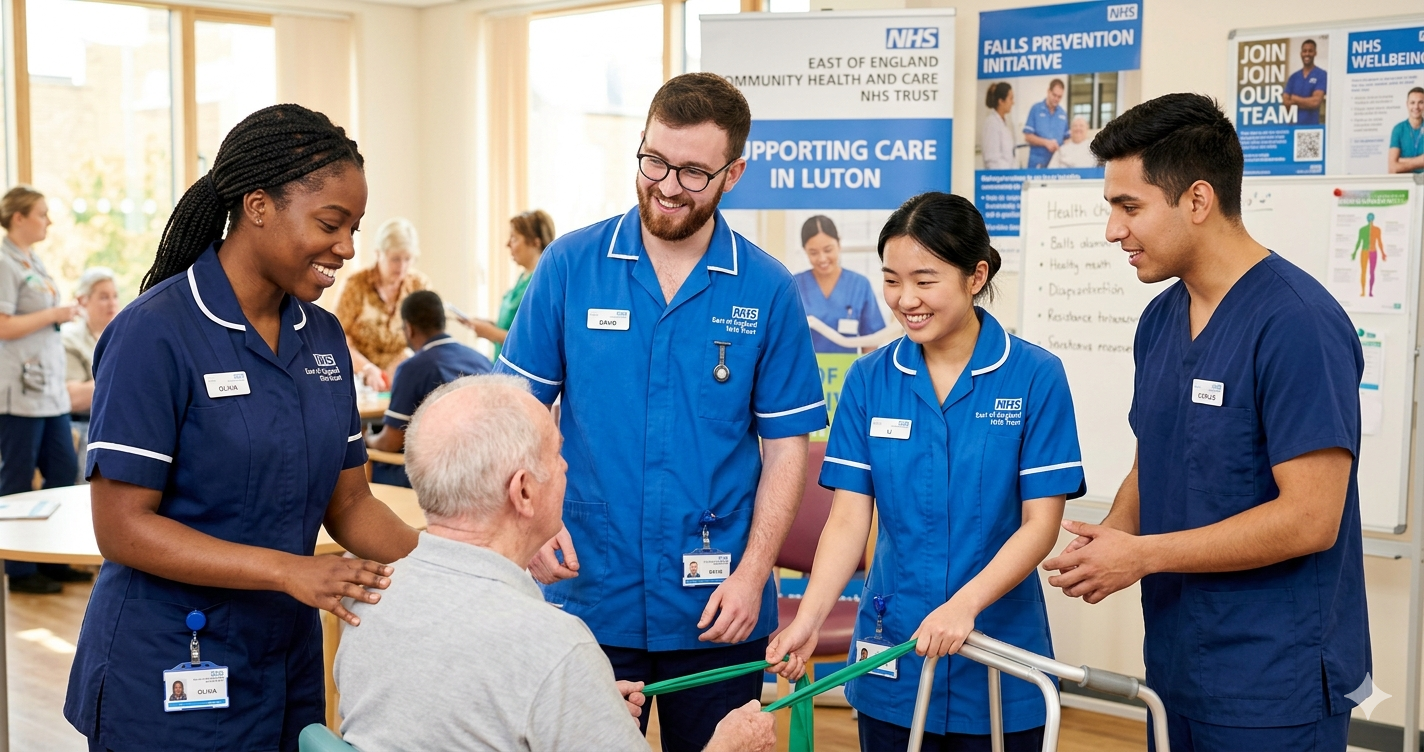
If you are a healthcare support worker with community experience and a driving licence, and you have been looking for an NHS role that genuinely fits around a more flexible schedule, this one is worth your full attention. East of England Community Health and Care NHS Trust is hiring a Community Falls Support Worker based in Luton, and the combination of a Band 4 salary, confirmed Skilled Worker visa sponsorship and a part-time-friendly structure makes this a notably accessible opportunity by NHS standards. The role is specifically open to candidates currently working at Band 3 or Band 4 who want to develop their practice in a specialist community setting.
What separates falls support work from standard community care roles is the clinical depth involved. This is not a straightforward personal care position. You will be completing evidence-based assessments in patients’ own homes, facilitating strength and balance exercise classes, making referrals across services and working with a degree of autonomy that many healthcare support workers only encounter at a more senior grade. For someone with the right background, it represents a meaningful step forward rather than a lateral move.
The salary sits between £28,392 and £31,157 per year on the NHS Agenda for Change pay framework, which corresponds to Band 4. The role is full-time in its contracted nature, but the original listing specifically mentions part-time interest, and the trust accepts flexible working requests. International applicants are explicitly welcomed, with the Certificate of Sponsorship pathway confirmed in the vacancy details.
Job Overview
| Field | Details |
| Job Title | Community Falls Support Worker |
| Employer | East of England Community Health and Care NHS Trust |
| Location | Luton, Cambridgeshire, United Kingdom |
| Salary | £28,392 to £31,157 per year |
| Contract Type | Full-Time |
| Hours | Not specified (part-time interest noted in listing) |
| Visa Sponsorship Status | Skilled Worker sponsorship available |
| Closing Date | 19 April 2026 |
| Interview Date | Not specified |
What You’d Actually Be Doing
- Responding to fall referrals promptly: When a patient is referred to the falls team, you are one of the first responders. This means triaging incoming referrals, registering them on the system and prioritising based on the service’s key performance indicators. Speed and accuracy both matter here.
- Visiting patients in their homes to carry out falls assessments: The majority of your working week will be spent out in the community, not in a clinic. You will travel to patients’ homes or places of residence, conduct comprehensive falls assessments and identify what equipment, care adjustments or further referrals are needed to keep them safe where they live.
- Running falls prevention exercise classes: This is one of the more distinctive aspects of the role. You will help facilitate the Luton Falls Team’s strength and balance group programme, which includes supporting patient reviews, conducting exercise assessments and providing education and psychological support to participants.
- Making evidence-informed recommendations: Based on what you observe in assessments, you will advise patients and their carers on practical changes that can reduce their risk of falling again. These recommendations need to be grounded in the assessment findings, not generic.
- Coordinating referrals to other services: Falls rarely exist in isolation. Patients often need input from physiotherapy, occupational therapy, social care or other community teams. Identifying these needs and making timely referrals is a core part of the job.
- Following up to confirm care is in place: Once equipment is ordered or a referral is made, you are responsible for checking that things have actually happened. This follow-up work is important in a community setting where patients can fall through the gaps between services.
- Maintaining accurate electronic patient records: All casework is documented on an electronic patient record system. You will need to keep records current and work alongside the Falls Coordinator to contribute to data collation and analysis.
- Managing your own workload independently: This is a lone-working role for the most part. You will be planning and prioritising your own schedule on a daily basis, which requires genuine self-management rather than waiting to be directed.
Who They’re Looking For
Must-haves:
- NVQ Level 3 or a degree-level qualification, or an equivalent such as a BSc, MSc, or Diploma that provides entry-level qualification into the physiotherapy profession
- Experience working in a community healthcare setting
- Proven ability to manage your own time, organise your workload and set priorities without close supervision
- Practical experience facilitating exercise classes or physical activity sessions
- Experience working independently in a lone-working capacity
- Experience providing equipment to patients or service users
- A car you own and a valid UK driving licence
- Competent IT skills including Microsoft Word, Excel and PowerPoint
Nice-to-haves:
- Familiarity with SystmOne or a comparable electronic patient records system
- Experience providing patient education and health advice
- Training in falls prevention or related health topics
If you meet most of the essential criteria but have not yet ticked every box on the desirable list, that should not stop you from applying. The trust is looking for a capable, community-experienced candidate who can grow into the role, not someone who has already done every single aspect of it elsewhere.
What Most Applicants Get Wrong
1. Submitting a generic NHS application form without tailoring it specifically to the falls service context.
Falls support work is a niche community specialism. A supporting statement that describes general care experience without connecting it to the specific demands of falls assessment, exercise facilitation and lone working will look thin next to candidates who address the person specification point by point. Every section of your supporting statement should map to a criterion in the job description, using your own real examples as evidence.
2. Not addressing the lone working and self-management requirements directly.
NHS hiring managers for community roles pay close attention to how applicants describe their ability to work without direct supervision. Candidates who focus entirely on clinical skills and forget to demonstrate their independence, time management and decision-making under pressure often fail to progress past the initial shortlisting stage. Think of specific situations where you managed a complex workload or made a judgement call without a senior colleague immediately available.
3. Arriving at interview underprepared for questions about falls risk, patient safety and clinical decision-making within scope.
This role sits at the intersection of community care and allied health. Interviewers will expect you to demonstrate some understanding of falls risk factors, the principles of holistic assessment and how you would handle a situation where a patient’s needs exceed your competency level. Candidates who have not thought through these scenarios before the interview often struggle under values-based questioning.
How to Apply (and Actually Get Noticed)
- Go to apps.trac.jobs and search for the vacancy reference 7931600. This is the official NHS recruitment portal used by the trust, and the application must be submitted through that system.
- Create or log in to your Trac.jobs account. If this is your first NHS application, take time to complete your profile carefully. Your employment history, qualifications and personal statement are all submitted through the platform.
- Before writing anything, print out or open the person specification alongside your application. Address every essential criterion in your supporting statement with a concrete example from your own experience.
- When writing about your community experience, be specific about the setting, the type of patients you worked with and the level of independence you operated with. Vague descriptions of previous roles do not shortlist well.
- If you have experience facilitating any kind of group exercise, physical activity or rehabilitation class, give it dedicated attention in your statement. This is listed as an essential requirement and is one of the more unusual asks for a healthcare support worker vacancy.
- Confirm that your driving licence is current and that your car is available for work purposes. This is a non-negotiable essential requirement. You will need to be able to reach patients across the community independently.
- If you are applying from overseas and require visa sponsorship, tick the relevant box in the application. The trust has confirmed it welcomes these applications and will consider them on equal terms. There is no need to address sponsorship in your supporting statement.
- Submit your application before the closing date of 19 April 2026. NHS application portals can experience high traffic near deadlines. Aim to submit at least 24 hours early to avoid any technical issues.
Visa and Eligibility
East of England Community Health and Care NHS Trust has confirmed that applications from candidates who require current Skilled Worker sponsorship are welcome and will be assessed alongside all other applications. This is a straightforward and positive position. The trust is a licensed NHS employer, which means it has the infrastructure in place to issue a Certificate of Sponsorship if you are offered and accept the role.
The salary band of £28,392 to £31,157 sits at NHS Band 4, which typically meets the threshold for the Skilled Worker route, particularly under the health and care worker category. That category also carries a reduced visa application fee and exempts the main applicant and their dependants from the Immigration Health Surcharge, which is a meaningful financial saving for relocating international workers.
If you have lived outside your current country of residence for 12 months or more, cumulatively or continuously, in the past ten years, you will also need to provide a criminal record certificate from the relevant country as part of the visa process. Guidance on this requirement is available directly from the UK Visas and Immigration website at www.gov.uk/government/organisations/uk-visas-and-immigration.
Frequently Asked Questions
Here are answers to the most common questions people ask about this Community Falls Support Worker role at East of England Community Health and Care NHS Trust, including eligibility, interview format, visa requirements and what to expect from the application process.
Do I need a physiotherapy degree to apply for this NHS falls support worker job?
No, a physiotherapy degree is not required. The essential qualification is an NVQ Level 3 or an equivalent qualification at that level, which includes a BSc, MSc or Diploma that provides entry-level qualification into the physiotherapy profession. The listing is designed to be accessible to experienced healthcare support workers who have built their skills through practice rather than a full degree programme.
Is this role really part-time or is it full-time?
The contract type is listed as full-time, but the original vacancy specifically invites interest from Band 3 or Band 4 workers looking for part-time opportunities. This suggests the trust may be open to flexible working arrangements. It is worth raising the question of hours at interview or after receiving a job offer, as NHS trusts are generally obliged to consider all flexible working requests.
Can I apply if I am currently at Band 3 rather than Band 4?
Yes. The listing specifically addresses candidates currently working at Band 3 or Band 4, indicating that Band 3 applicants who can demonstrate readiness to step up are welcome. If you are at Band 3, your supporting statement should focus on the depth of your community experience and your readiness to take on the greater autonomy and assessment responsibilities that come with a Band 4 post.
What does a typical week look like for a community falls support worker?
Most of your working time will be spent visiting patients in their homes across the Luton area, which means a significant amount of driving between appointments. You will also have regular involvement with the falls exercise class programme and will spend time on patient record keeping and referral coordination. It is an active, varied role with little time spent sitting at a desk.
Will I need to have a DBS check before starting this role?
Yes. This post is subject to an enhanced Disclosure and Barring Service check under the Rehabilitation of Offenders Act exceptions. For international applicants, a criminal record certificate from any country where you have lived for 12 months or more in the past ten years is also required as part of the visa application process.
What format does the interview take for NHS community support roles like this one?
NHS interviews for community-facing support roles almost always use a values-based competency format. You will be asked to describe specific situations from your past experience using a structured approach, typically covering what the situation was, what you did and what the outcome was. For this particular role, expect questions focused on lone working, patient safety, clinical boundaries and how you manage a varied caseload.
Does the employer cover relocation costs for international applicants?
The listing does not mention a relocation package. This is standard for NHS Band 4 roles, which do not typically include relocation support. Any relocation costs would generally be the responsibility of the applicant, which is worth factoring into your decision if you are applying from outside the UK.
What is SystmOne and do I need to know it to get this job?
SystmOne is a widely used electronic patient records system across NHS community and primary care services in England. Familiarity with it is listed as desirable rather than essential, which means you will not be rejected for not knowing it. If you have used any comparable electronic records system in a previous role, this is worth mentioning in your application, as the underlying skills transfer readily.
How competitive is this NHS falls support worker vacancy likely to be?
Falls prevention is a growing area of NHS community care, and roles that combine clinical assessment skills with exercise facilitation are relatively specialised. The essential requirement for community experience combined with exercise class facilitation experience means the eligible applicant pool is narrower than for a general healthcare support worker vacancy. Candidates who can demonstrate both community independence and group delivery experience in their supporting statement are likely to stand out.
Official Application Link
To apply, visit the Trac.jobs portal and submit your application for the Community Falls Support Worker role at East of England Community Health and Care NHS Trust. The closing date is 19 April 2026.