

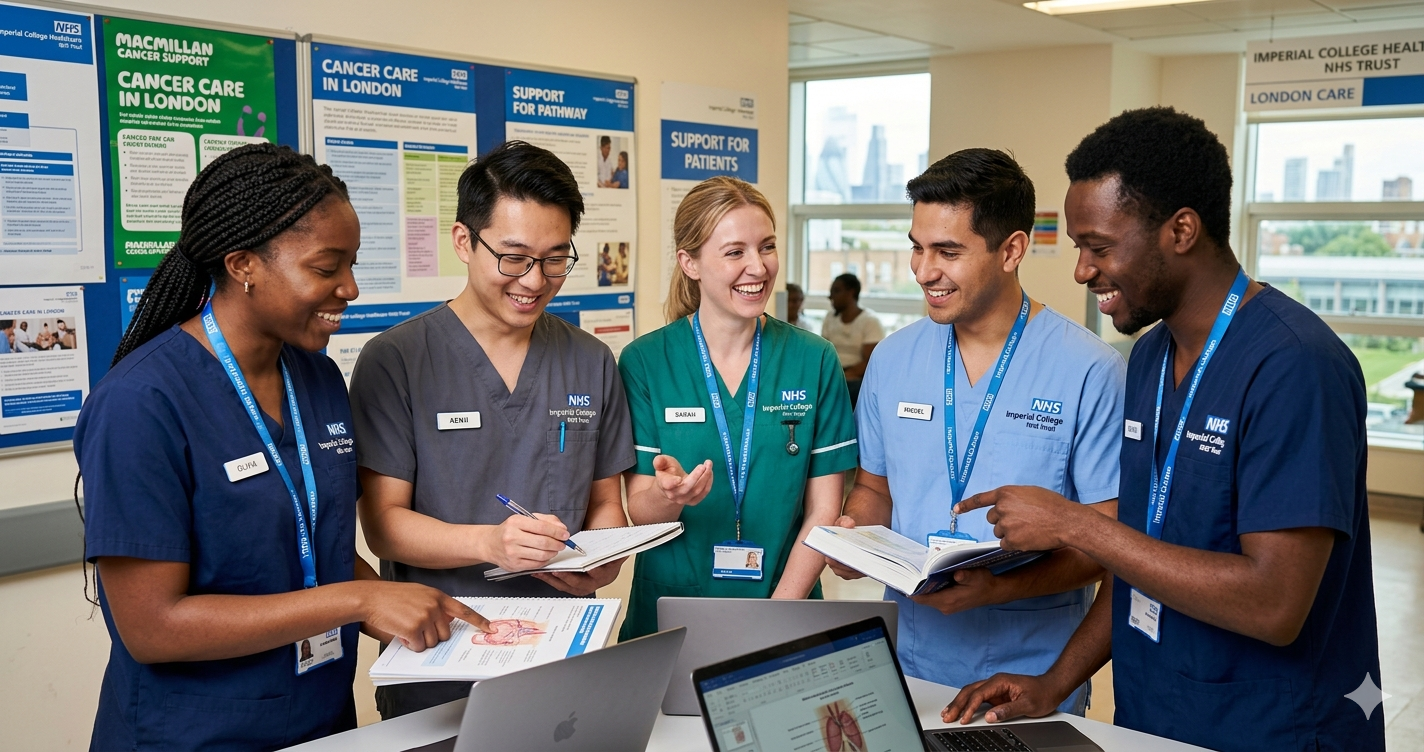
Working within a haematology cancer team at one of London’s most prominent NHS trusts is not a common opportunity at healthcare support worker level, and that is precisely what makes this vacancy stand out. Imperial College Healthcare NHS Trust, which runs five major hospitals across west and north-west London including St Mary’s and Hammersmith, is recruiting into its Haematology Cancer Clinical Nurse Specialist team through Macmillan Cancer Support funding. The salary sits between £34,186 and £37,389 per year, placing it comfortably within NHS Band 5 territory and well above what most support worker roles in the capital offer at this level.
The role is shaped by a model called personalised care, which is central to how the NHS now approaches cancer support. Rather than simply reacting to clinical events, the team works proactively with patients from diagnosis through to end of life or recovery, addressing emotional, practical and clinical needs in a coordinated way. For a healthcare support worker who wants to develop meaningful specialist experience in oncology without being required to hold a nursing degree, this represents a rare and genuinely substantive step up.
Skilled Worker visa sponsorship is confirmed and explicitly offered on equal terms to all applicants. The closing date is 21 April 2026, which leaves a short window to prepare a strong application. If you have direct experience supporting patients with cancer and their families, and you are comfortable working with both clinical and administrative responsibilities, this is worth acting on quickly.
Job Overview
| Field | Details |
| Job Title | Macmillan Cancer Support Worker |
| Employer | Imperial College Healthcare NHS Trust |
| Location | London, United Kingdom |
| Salary | £34,186 to £37,389 per year |
| Contract Type | Full-Time |
| Hours | Not specified |
| Visa Sponsorship Status | Skilled Worker sponsorship available |
| Closing Date | 21 April 2026 |
| Interview Date | Not specified |
What You’d Actually Be Doing
- Supporting Clinical Nurse Specialists with holistic patient care: Much of the role involves working directly alongside a team of ten Cancer CNSs in the haematology specialty. You will assist with needs assessments and help develop individual care plans for patients, meaning you are close to the clinical heart of the service rather than operating at a distance from it.
- Coordinating patient pathways from referral to treatment: You will be responsible for arranging assessments, booking appointments and ensuring investigations happen in a timely way. In a busy London acute trust, this kind of coordination work is demanding and genuinely important to patient outcomes.
- Carrying out clinical observations and basic procedures: This is not purely an administrative or support role. You will be taking vital signs, collecting specimens and conducting basic diagnostic tests, which means there is a hands-on clinical component to the work throughout the week.
- Identifying and escalating safeguarding concerns: When working with cancer patients who may be vulnerable or distressed, you will be expected to recognise signs of abuse or vulnerability and escalate them through the correct channels. This is a serious responsibility that requires both awareness and confidence.
- Communicating sensitively across patients, families and care settings: A significant part of the job is talking with people who are at extremely difficult points in their lives, from the moment of diagnosis through to end of life. Excellent communication skills are not a nice-to-have here; they are what the role is built around.
- Covering colleagues and contributing to team operations: You will be expected to provide cover for colleagues when needed and to participate actively in team meetings and service development work. This is a collaborative team, and your ability to be flexible and reliable will matter.
- Managing your own workload with appropriate escalation: While you will have direct CNS supervision available, you are expected to organise and prioritise your daily work independently. Knowing when to escalate and when to manage something yourself is a judgement call you will make regularly.
- Maintaining accurate patient records and upholding confidentiality: All documentation, including records related to assessments, care plans and patient interactions, must be kept current and compliant. Given the sensitive nature of cancer care, the importance of confidentiality in this setting cannot be overstated.
Who They’re Looking For
Must-haves:
- GCSEs at grade A to C in both Maths and English, or equivalent
- NVQ Level 3 in Health and Social Care, or equivalent, or actively working towards it
- Educated to foundation degree level, or able to demonstrate equivalent experience and knowledge
- Direct experience working with cancer patients and their families
- Experience handling complex and emotionally sensitive situations on a regular basis
- Experience communicating and coordinating across different care settings and providers
- Previous experience in direct patient care as a healthcare assistant, at NHS Band 3 or equivalent, or in a comparable health or social care role
- Ability to organise and prioritise your own workload and seek guidance when appropriate
- Flexibility and adaptability to changing clinical circumstances
- Demonstrated ability to work on your own initiative without constant direct supervision
Nice-to-haves:
- Experience working within an NHS acute trust or a multidisciplinary team
- Experience with reception or front-facing public-facing work, both in person and by phone
- Experience managing patient records or working with databases
- Good IT skills including spreadsheets, email, word processing and database applications
- Knowledge of health promotion principles
- Experience performing holistic needs assessments (HNA)
- Specialty knowledge of haematology or oncology pathways
- Willingness to undertake further study, including diploma or degree-level training, relevant to the role
If you have not worked specifically in haematology before, that should not stop you from applying. The listing is clear that specialist training will be provided, and the trust is looking for the right foundations of experience and values rather than a fully formed oncology specialist.
What Most Applicants Get Wrong
1. Writing a supporting statement that focuses too heavily on general care skills without addressing the specific cancer and haematology context.
This team sits within a specialist Macmillan-funded haematology CNS service, which means the panel will be looking for evidence that you understand the particular emotional and clinical landscape of cancer care. Generic statements about being a compassionate team player do not differentiate candidates in a shortlisting pool where everyone applying has some patient care background. Connect your experience to the realities of cancer pathways, sensitive communication and supporting patients through uncertainty.
2. Underestimating how much weight the panel will give to emotional resilience and communication under pressure.
Cancer support work at an acute London trust is emotionally demanding in a consistent, sustained way. Applicants who describe their communication skills in general terms without demonstrating specific experience of managing distressed patients, breaking difficult news alongside a clinical team, or maintaining professional composure in emotionally intense situations are leaving out the evidence the panel most needs to see. If you have stories from your practice that show this, they belong in your application.
3. Arriving at interview without a working understanding of personalised care, holistic needs assessments and the NHS Long Term Plan for cancer.
Imperial is a world-class academic trust and its cancer services operate within a clearly defined national framework. Interviewers will expect candidates to understand what personalised care means in an oncology context and to be able to articulate why holistic needs assessments matter for patient outcomes. Candidates who arrive knowing only the clinical tasks in the job description without understanding the model behind the service will struggle with the more probing questions.
How to Apply (and Actually Get Noticed)
- Go to apps.trac.jobs and search for vacancy reference 7887353. This is the official NHS recruitment portal for this role and the only valid application route.
- Create or log into your Trac.jobs account. If you are new to the platform, complete your profile carefully. Your employment history and qualifications entered here will carry across to any other NHS applications you submit.
- Before writing a single word of your supporting statement, open the person specification alongside a blank document and work through each essential criterion one by one. Your statement needs to provide a concrete example for every point, not a general claim that you meet it.
- When addressing your cancer patient experience, be specific about the setting, the type of patients, the complexity involved and what your role actually was. The panel needs to picture you in those situations, not read a summary of your job description.
- Address your experience with sensitive communication directly and with examples. If you have supported a patient and family through a terminal diagnosis, through treatment side effects or through end of life planning, describe what that involved and how you managed it professionally.
- If you are currently working towards your NVQ Level 3 rather than having already completed it, state that clearly and include your expected completion date. The listing says “working towards” is acceptable, and clarity here is better than leaving it ambiguous.
- If you require Skilled Worker sponsorship, indicate this in the relevant field of the application. You do not need to address it in your supporting statement. The trust has confirmed it welcomes these applications and assesses them on the same basis as domestic applicants.
- Submit your application well before 21 April 2026. NHS application systems can be slow when multiple candidates are submitting close to the deadline. Aim to submit at least 24 to 48 hours early to avoid any platform issues.
Visa and Eligibility
Imperial College Healthcare NHS Trust has confirmed that applications from candidates who require current Skilled Worker sponsorship are welcome and will be considered on exactly the same basis as all other applicants. This is a clear, unambiguous statement rather than a cautious disclaimer, which makes it a genuine option for internationally based candidates who qualify.
The salary band of £34,186 to £37,389 per year sits within NHS Band 5 equivalent pay, which comfortably meets the Skilled Worker route salary threshold. NHS roles in this salary range also typically qualify under the health and care worker visa category, which offers lower visa fees and exempts the main applicant and their dependants from the Immigration Health Surcharge. For anyone relocating internationally, that surcharge exemption alone represents a significant saving.
Applicants who have lived outside their current country of residence for a cumulative or continuous period of 12 months or more in the past ten years will need to provide a criminal record certificate from the relevant country as part of the visa application. Full guidance is available from the UK Visas and Immigration website at www.gov.uk/government/organisations/uk-visas-and-immigration and from the overseas criminal records checks guidance at www.gov.uk/government/publications/criminal-records-checks-for-overseas-applicants.
Frequently Asked Questions
Here are answers to the most common questions people ask about this Macmillan Cancer Support Worker role at Imperial College Healthcare NHS Trust, including eligibility, interview format, visa requirements and what to expect from the application process.
Do I need a nursing qualification to apply for this cancer support worker role at Imperial?
No nursing qualification is required for this role. The essential qualifications are GCSEs in Maths and English, an NVQ Level 3 in Health and Social Care or equivalent (or progress towards it), and education to foundation degree level or equivalent experience. The role is designed for experienced healthcare support workers, not registered nurses, and the clinical tasks are carried out under the supervision of Clinical Nurse Specialists.
What does a Macmillan Cancer Support Worker actually do day to day at an NHS trust?
On a typical day you would support Clinical Nurse Specialists with patient assessments and care planning, arrange appointments and coordinate care pathways, take clinical observations, speak with patients and families who are navigating active treatment or end of life care, and maintain patient records. The balance between clinical, coordination and communication work varies depending on the team’s caseload on any given day.
Is this NHS job suitable for someone who has worked in cancer care outside the UK?
Yes, experience of working with cancer patients and their families gained outside the UK is relevant and applicable for this role. The essential criteria do not restrict experience to NHS settings, and the trust explicitly welcomes applications from candidates requiring Skilled Worker visa sponsorship. If your overseas experience includes holistic assessment, complex communication or multidisciplinary teamwork, these transfer directly to what the role requires.
What is the Macmillan Cancer Support Worker salary at Imperial College Healthcare NHS Trust?
The salary for this role is between £34,186 and £37,389 per year, set within the NHS Agenda for Change pay framework. This is a fixed-band salary and is not individually negotiable. Where on the band you start will typically depend on your existing relevant experience. Progression through the band happens incrementally over time in line with standard NHS terms.
What will the interview look like for a cancer support worker role at an NHS acute trust?
NHS interviews at acute trusts for cancer support roles typically use a values-based competency format, where candidates are asked to describe specific situations from their professional experience. Questions are likely to focus on your approach to sensitive communication, how you have managed emotionally difficult situations, your understanding of personalised cancer care and how you handle competing priorities in a busy clinical environment. You should be prepared to discuss what holistic needs assessments are and why they matter.
Will I need to do a DBS check if I am offered this role?
Yes. This post requires an enhanced Disclosure and Barring Service check under the Rehabilitation of Offenders Act exceptions order. For international applicants who have lived outside their current country of residence for 12 months or more in the past ten years, a criminal record certificate from the relevant country is also required as part of the Skilled Worker visa application process.
Is Imperial College Healthcare NHS Trust a good employer for overseas NHS workers?
Imperial College Healthcare NHS Trust is one of the largest NHS trusts in England and runs some of the country’s most recognised hospital sites, including St Mary’s Hospital in Paddington and Charing Cross Hospital. It is affiliated with Imperial College London and has a long track record of supporting internationally recruited staff. The trust’s size means it has structured induction processes, professional development pathways and dedicated staff support resources, which matters particularly for candidates relocating from overseas.
What does “working towards NVQ Level 3” mean and can I still apply if I have not finished mine?
If you are currently enrolled in and actively working towards an NVQ Level 3 in Health and Social Care, you are eligible to apply. The listing specifically states “working towards” as an acceptable status for the qualification criterion. You should make your current stage of study clear in your application and include your expected completion date so the hiring team can assess your position accurately.
Does the Macmillan branding on this role mean it is funded differently from standard NHS posts?
Yes. This role is funded through Macmillan Cancer Support, which is one of the UK’s largest cancer charities and a long-standing partner of NHS trusts in delivering specialist oncology services. Macmillan-funded posts are embedded within NHS teams and carry the same NHS employment terms and conditions, including pay, leave and pension arrangements. The Macmillan funding means the post is specifically focused on the cancer support and personalised care agenda, which shapes both the role’s priorities and the level of specialist training available to the postholder.
Official Application Link
To apply, visit the Trac.jobs NHS recruitment portal and submit your application for the Macmillan Cancer Support Worker role at Imperial College Healthcare NHS Trust. The closing date is 21 April 2026.