
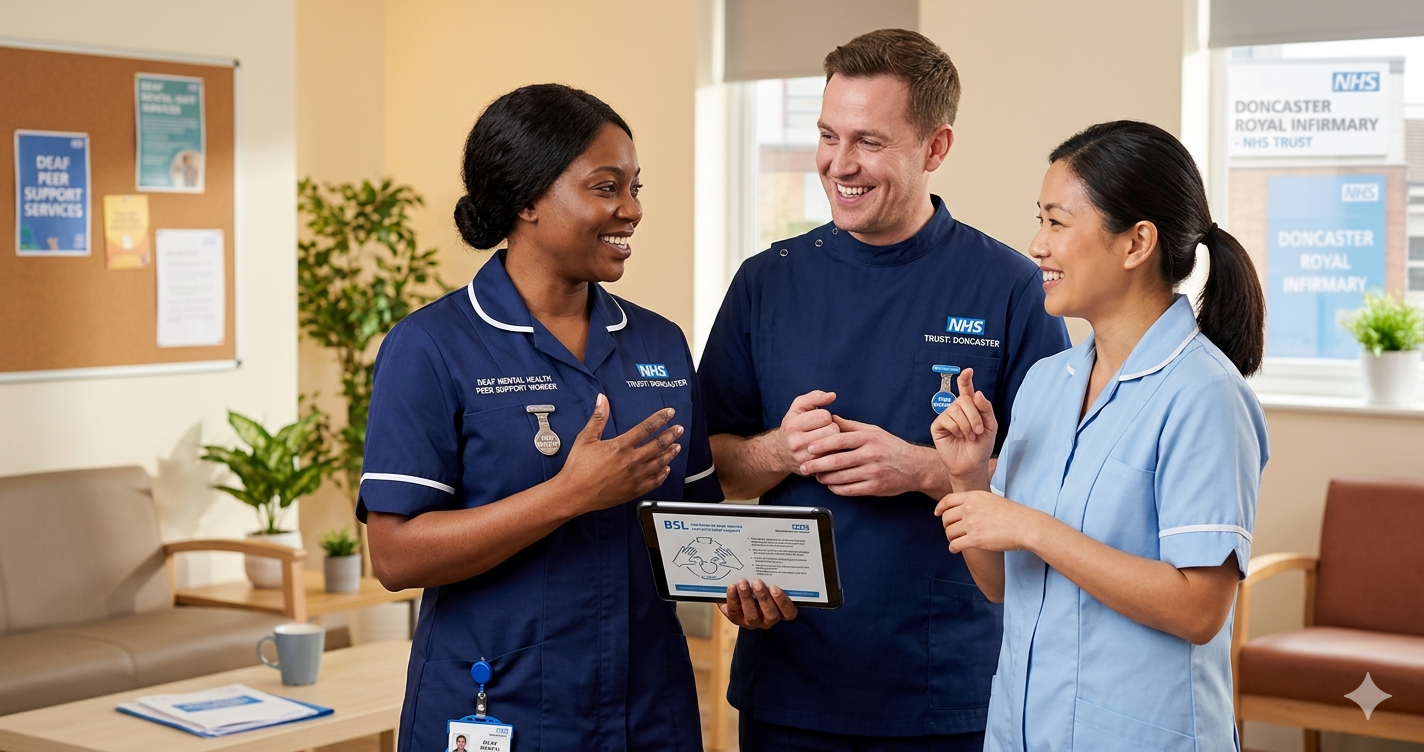
If you are a fluent British Sign Language user with lived experience of Deaf culture and an interest in mental health, this role was genuinely built around people like you. Rotherham Doncaster and South Humber NHS Foundation Trust has created a brand new position to bridge the gap between Deaf communities and mental health services across South Yorkshire, and they are explicitly welcoming applications from candidates who need Skilled Worker visa sponsorship to take it up.
What makes this worth paying close attention to is the combination of factors that rarely appear together in a single NHS vacancy. The salary sits between £28,392 and £31,157 per year on Band 5 equivalent terms, the hours are Monday to Friday with no night shifts or weekend requirements built into the standard pattern, and the role does not demand a degree. What it does demand is fluency in BSL and genuine insight into what it means to be Deaf in a healthcare system that was not designed with you in mind. That is a very different kind of qualification.
This is also a genuinely new service. There is no established team dynamic to slot into and no predecessor in the role to compare yourself to. The person hired will help shape how Deaf mental health peer support actually works across Barnsley, Doncaster, Rotherham and Sheffield. For someone with the right background, that is a rare and meaningful kind of opportunity.
Job Overview
| Field | Detail |
| Job Title | Deaf Mental Health Project Peer Support Worker |
| Employer | Rotherham Doncaster and South Humber NHS Foundation Trust |
| Location | Doncaster, South Yorkshire, United Kingdom |
| Salary | £28,392 to £31,157 per year |
| Contract Type | Full Time, Permanent |
| Hours | Monday to Friday, 9am to 5pm (with occasional flexibility for community events) |
| Visa Sponsorship Status | Skilled Worker sponsorship available |
| Closing Date | 22 April 2026 |
| Interview Date | Not specified |
What You’d Actually Be Doing
- Supporting Deaf BSL users to access mental health services: Much of the day-to-day involves being the bridge between services that are not always accessible and a community that has historically been underserved. This might look like attending appointments with service users, translating complex information into accessible BSL, or simply making someone feel seen.
- Drawing on your own lived experience: This is not a clinical role where you observe from a distance. The post is explicitly built on the value of personal experience, whether that means you are a Deaf BSL user yourself or grew up in a Deaf family. That lived understanding is the whole point.
- Running deaf awareness sessions for NHS staff and services: You will be going into healthcare settings and teaching colleagues what they need to know about Deaf culture and communication. This requires confidence in front of a room and the ability to adapt your message depending on your audience.
- Helping Deaf service users, carers and families have a say in shaping services: A big part of this role is about inclusion mechanisms, creating genuine routes for BSL users to influence how services are designed and delivered, rather than just being passive recipients.
- Providing information and signposting to the Deaf community: This means knowing what is out there, being able to explain it clearly and making sure people who need help can actually find it.
- Managing your own workload across a wide geographic area: The role covers four South Yorkshire localities, so self-organisation and the ability to manage competing priorities are genuinely important. You will not be supervised at every turn.
- Occasional flexible working for community engagement events: The standard hours are 9 to 5 but the role requires some flexibility when events fall outside those times. This is not a heavy ask but it is worth factoring in.
Who They’re Looking For
Must-haves:
- Five GCSEs at Grade 4 or above including English and Maths, or an equivalent qualification
- NVQ Level 3 in Health and Social Care, Community Development or equivalent
- Native BSL user, or holding a BSL qualification at Level 3 or above
- Experience engaging with patients, carers and members of the public
- Experience working with partners and stakeholders across organisations
- Demonstrable use of digital and social media platforms
- Strong IT skills including Microsoft Office
- Excellent written and verbal communication alongside clear BSL communication
- Understanding of the barriers Deaf people face when accessing mental health services
- Knowledge and understanding of Deaf culture
Nice-to-haves:
- Previous experience working within the NHS
If you meet the language and lived experience criteria but feel unsure about one or two of the others, it is worth applying anyway. This is a new role and the trust is clearly prioritising the right person over the perfect CV.
What Most Applicants Get Wrong
1. Writing a generic NHS application that does not connect lived experience to the specific purpose of this role
The entire premise of a peer support worker role is that your personal connection to the community matters. Applications that read like a standard health and social care submission miss the point entirely. The shortlisting panel will be looking for authenticity, not just a checklist of competencies. If your experience of Deaf culture or mental health is relevant, it needs to be front and centre in your supporting information, not buried in a final paragraph.
2. Underestimating the importance of the supporting statement and leaving it too short
NHS applications via Trac.jobs use a supporting statement as a core part of shortlisting. Many applicants treat it as an afterthought or simply restate their CV. For a role like this, where the person specification covers knowledge, values and lived insight as well as qualifications, a short or vague supporting statement is one of the most common reasons otherwise strong candidates do not make the cut.
3. Arriving at interview without being able to discuss the NHS’s equality and inclusion agenda in any depth
This post sits explicitly within an equality and inclusion framework. Candidates who arrive at interview with only a surface-level understanding of what that means in practice for Deaf service users are likely to struggle with the more probing questions. Interviewers will want to hear not just what you would do in this role, but why accessible mental health provision for BSL users matters and what the cost of getting it wrong looks like for real people.
How to Apply (and Actually Get Noticed)
- Read the full job description and person specification carefully before you write anything. This sounds obvious but many applicants skip straight to filling in the form. Every point on the person specification is a potential shortlisting criterion, and you need to address each one.
- Go to the official application portal at apps.trac.jobs and search for the vacancy using the reference number 7846519. The listing is also accessible directly from the Trac.jobs link on the original job page.
- Create or log in to your Trac.jobs account. If you are applying for NHS roles for the first time, set up your profile carefully. The information you enter here feeds into multiple NHS applications, so accuracy matters.
- Complete the employment history and qualifications sections in full. Do not leave gaps unexplained, especially if you have spent time studying or working abroad.
- Write your supporting statement with the person specification open in a separate tab. Go through each criterion and make sure your statement gives concrete evidence for it. For the knowledge and values criteria, use specific examples from your own life, not hypothetical answers.
- Be direct about your BSL background early in the statement. This role is unusual in that your language and community identity are primary qualifications. Do not bury them.
- If you require Skilled Worker sponsorship, tick the relevant box in the application. The trust has confirmed it welcomes applications from candidates who need sponsorship and will consider them alongside all other applicants. You do not need to justify this in your supporting statement.
- Submit your application before 22 April 2026. NHS systems can be slow during high-traffic periods near deadlines, so aim to submit at least 24 hours early.
- Be prepared that you may be asked about your DBS (Disclosure and Barring Service) history. This role is subject to an enhanced DBS check. If you are applying from overseas, you will need to provide criminal record certificates from any country where you have lived for 12 or more consecutive months in the past ten years.
Visa and Eligibility
This role is listed with Skilled Worker visa sponsorship explicitly available. The trust has confirmed in the job posting that applications from candidates who require current Skilled Worker sponsorship are welcome and will be assessed on the same basis as all other applicants. That is a straightforward and positive position compared to many NHS vacancies where sponsorship eligibility is left ambiguous.
To be eligible for the Skilled Worker visa route, the role must meet the salary threshold set by the Home Office and be on the eligible occupation list. At £28,392 to £31,157, this role sits within NHS Band 5 equivalent pay, which typically qualifies under the health and care worker route. That route also carries lower visa fees and exemption from the Immigration Health Surcharge for the main applicant and their dependants, which is a meaningful financial saving.
If you have lived continuously or cumulatively for 12 months or more in any country other than your current one in the past ten years, you will need to provide a criminal records certificate from that country as part of the visa application process. Official guidance on overseas criminal record checks is available at the UK Visas and Immigration website.
Frequently Asked Questions
Here are answers to the most common questions people ask about this Deaf Mental Health Project Peer Support Worker role at Rotherham Doncaster and South Humber NHS Foundation Trust, including eligibility, interview format, visa requirements and what to expect from the application process.
Do I need to be Deaf myself to apply for this role?
You do not need to be Deaf yourself, but you must be a native BSL user or hold a BSL qualification at Level 3 or above. The role is also open to people who grew up in a Deaf family, such as children of Deaf adults (sometimes referred to as CODAs), who use BSL as part of their everyday life. What the trust is looking for is genuine cultural connection and fluency, not a specific audiological status.
Is a degree required for this NHS peer support worker job in Doncaster?
No degree is required for this role. The essential qualifications are five GCSEs at Grade 4 or above including English and Maths, and an NVQ Level 3 in Health and Social Care, Community Development or an equivalent qualification. This makes it accessible to candidates who have built their expertise through community work and lived experience rather than academic study.
Will the NHS trust sponsor a visa for this peer support worker position?
Yes. The listing explicitly states that applications from candidates requiring Skilled Worker visa sponsorship are welcome and will be considered alongside all other applications. The trust has provided a direct link to the UK Visas and Immigration guidance page, which is a strong indicator that this is a genuine offer rather than a tokenistic one.
What is the salary for this role and is it negotiable?
The salary is £28,392 to £31,157 per year. NHS pay is set by the Agenda for Change pay framework and is not individually negotiable. Where on the band you start will typically depend on your existing experience, and incremental progression is built into the structure over time.
What does a typical working week look like for this post?
The standard working pattern is Monday to Friday, 9am to 5pm. There are no night shifts or weekend requirements built into the role. However, the post does require occasional flexibility when community engagement events fall outside standard hours. How often this happens will depend on the service’s event schedule, which is not fixed in advance.
What is the application deadline and can I apply late?
The closing date for applications is 22 April 2026. NHS applications through Trac.jobs have a hard cut-off and late submissions are not accepted. It is advisable to submit at least 24 hours before the deadline to avoid any technical issues with the system.
What kind of interview should I expect for an NHS peer support worker role?
NHS trusts typically use values-based interviews for peer support and community-facing roles, meaning questions are structured around the NHS Constitution values and ask for specific real-life examples rather than hypothetical responses. Given the nature of this role, expect questions that explore your understanding of Deaf culture, your insight into barriers to mental health access, and how you have drawn on your own experience to support others.
What DBS check is required and does it affect applicants from overseas?
This post requires an enhanced DBS (Disclosure and Barring Service) check under the Rehabilitation of Offenders Act exceptions. For applicants who have lived abroad for 12 months or more continuously or cumulatively in the past ten years, a criminal records certificate from the relevant country is also required as part of the Skilled Worker visa application process. Guidance for overseas applicants is available directly on the UK government website.
Can I apply if I have not worked in the NHS before?
Yes. Previous NHS experience is listed as desirable, not essential. The trust is looking primarily for lived connection to the Deaf community, BSL fluency and experience engaging with members of the public in health, social care or community settings. Candidates from community organisations, charities or advocacy backgrounds are well placed to apply.
Official Application Link
You can apply directly for the Deaf Mental Health Project Peer Support Worker role at Rotherham Doncaster and South Humber NHS Foundation Trust through the Trac.jobs portal. The closing date is 22 April 2026.