

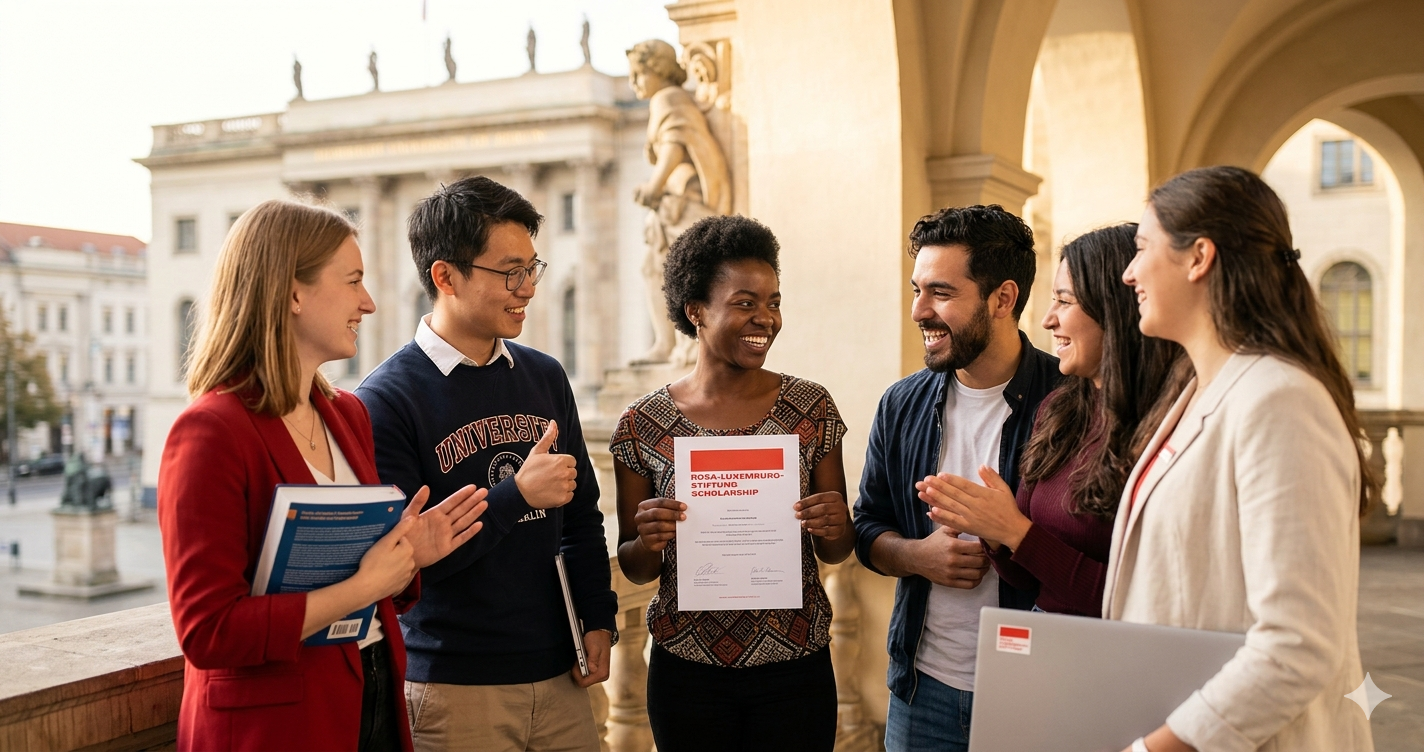
The Rosa-Luxemburg-Stiftung Scholarship is one of Germany’s most socially conscious funding programmes for undergraduate, Master’s and doctoral students. Unlike many academic scholarships that focus purely on grades, this foundation actively works to counteract social, political and gender discrimination in education. It gives particular weight to applicants from non-academic family backgrounds, migrant communities, lower-income households and people with disabilities, making it one of the more inclusive scholarship programmes available for study in Germany.
This scholarship is for students who combine strong academic performance with genuine social and political commitment. It is open to both German residents and international students, though the specific programmes available to you will depend on your citizenship status and the level of study you are pursuing. Whether you are starting a Master’s degree, continuing undergraduate studies or embarking on doctoral research, there is likely a strand of this programme worth exploring.
This post covers everything you need to know about the Rosa-Luxemburg-Stiftung Scholarship: who can apply, what each strand of the programme covers, what documents you will need, how to apply and what the foundation is really looking for in a successful candidate.
Scholarship Overview
| Field | Information |
| Host Country | Germany |
| Degree Level | Undergraduate, Master’s, PhD |
| Funding Type | Full scholarship (financial grant based on BAföG regulations) |
| Deadline | 1 October each year (for grants beginning the following summer semester) |
| Who Can Apply | German students, EU citizens, and international students residing in Germany for study or research |
| Benefits Summary | Financial grant, political education events, workshops, summer schools, symposia, academic support network |
Eligibility
Eligibility varies depending on which strand of the scholarship you are applying for. Read each category carefully before applying.
Citizenship:
- German passport holders are eligible for the full study scholarship programme.
- EU citizens may apply for study scholarships under limited funding provisions.
- International (non-EU) students may apply for the international strand, which covers Master’s and PhD students temporarily residing in Germany.
- International students who meet the criteria set out in section 8 of the German Federal Law on Education and Training (BAföG) may also be eligible for the domestic study scholarship.
Academic qualifications:
- You must demonstrate above-average academic achievement at school or university level.
- For Master’s study scholarships, you must be enrolled at a state or state-recognised German university.
- Students in a state examination or diploma course must have completed their basic studies before applying.
- PhD applicants must be accepted at a German university. Doctoral candidates in medicine, dentistry and veterinary medicine are not eligible.
- For the Lux like Studium strand, you must be a school student or first-generation university student from a non-academic background.
Work experience (if applicable):
- Not specified as a requirement.
Language requirements:
- German language proficiency at B2 level or above is required.
- The application platform and all application documents are currently available in German only.
Other requirements:
- You must demonstrate political and social engagement in line with the aims and values of the Rosa-Luxemburg-Stiftung, which broadly reflect left-progressive, democratic and social justice principles.
- Preference is given to applicants from non-academic family backgrounds, migrant backgrounds, low-income households and applicants with disabilities who show comparable academic achievement and commitment.
- International students applying for the study scholarship must plan to return to their home country after completing their studies in Germany.
Eligible Countries
The scholarship is primarily administered in Germany and targets students residing in Germany for study or research purposes. Country eligibility depends on the strand.
Europe:
- Germany (all study scholarship strands)
- All other EU member states (limited funding for study scholarships; full eligibility for doctoral scholarships)
Africa, Asia, Americas, Middle East, Oceania:
- Students from all countries outside the EU may apply for the international scholarship strand (Master’s and PhD only), provided they are temporarily residing in Germany for study or research purposes.
Eligible Fields of Study
The Rosa-Luxemburg-Stiftung Scholarship is broadly open across disciplines, with some important exceptions.
- Study scholarships (undergraduate and Master’s): Open to students from all fields and all state-approved institutions of higher education in Germany.
- PhD scholarships: Open to doctoral students from all disciplines except medicine, dentistry and veterinary medicine.
- Applications from students in scientific and technical disciplines are actively encouraged, as are applications from graduates of technical colleges.
This scholarship is open to all fields of study, with the exception of medical, dental and veterinary medicine at PhD level.
Benefits
The foundation does not publish a fixed monthly stipend figure on its English-language pages. The amount of funding is determined in accordance with BAföG regulations, which means it varies based on your personal and financial circumstances.
- Financial grant: A monthly stipend calculated according to German BAföG regulations. The amount depends on your individual situation.
- Duration: For PhD scholarships, funding typically lasts for three years. For study scholarships, the duration follows BAföG rules and depends on the length of your programme.
- Political education events: Scholarship holders are invited to workshops, summer schools, symposia and educational trips, both in Germany and abroad.
- Practical skills training: The foundation organises training in areas including rhetoric, conflict management, time management, academic writing and research methodology.
- Academic support network: Over 250 academic advisers, alongside foundation staff and wider networks, support the scholarship holders throughout their studies.
- Community and self-organisation: Scholarship holders can form and participate in working groups, supported by the foundation’s infrastructure.
Required Documents
The application forms and all required documents are available in German only on the foundation’s applications page. Below is a general checklist based on the information provided. Verify the complete and current list on the official German-language applications page.
- Completed application form (downloaded from the Rosa-Luxemburg-Stiftung applications page, in German)
- Proof of enrolment at a state or state-recognised German university
- Academic transcripts showing above-average achievement
- Degree certificate or school-leaving certificate (as applicable to your level of study)
- Proof of German language proficiency at B2 level or above
- Evidence of social and political engagement (this may include references, letters, or a personal statement)
- Personal statement or motivation letter outlining your academic goals and social commitment
- Proof of personal or family background relevant to the foundation’s preference criteria (non-academic background, migrant background, disability status, etc.) where applicable
- For PhD applicants: confirmation of acceptance at a German university and a research proposal
- For international applicants: valid residence permit showing you are temporarily residing in Germany for study or research
Note: Documents cannot be sent by post. All materials must be submitted through the official online application process.
How to Apply
Step 1: Visit the official Rosa-Luxemburg-Stiftung website and navigate to the Scholarship Department section. Note that the applications page is available in German only, so prepare accordingly.
Step 2: Identify which strand of the scholarship applies to you: the standard study scholarship, the Lux like Studium programme for first-generation students, or the PhD scholarship. Each has distinct criteria.
Step 3: Check your eligibility carefully against your citizenship, residency status, level of study and language proficiency. If you are unsure, contact the scholarship department by phone or email during consultation hours before proceeding.
Step 4: Download the application form and all supporting document templates from the official applications page. Do not use unofficial or outdated versions.
Step 5: Prepare your supporting materials. Focus particularly on demonstrating your social and political engagement, as this is weighted alongside academic achievement. Think about specific activities, campaigns, community involvement or advocacy work you can reference with evidence.
Step 6: Write your personal statement or motivation letter in German, addressing your academic goals, your commitment to social justice, and how your background or experience aligns with the values of the Rosa-Luxemburg-Stiftung.
Step 7: Gather all supporting documents. Ensure your German language certificate is current and at the B2 level or above. If you are from a non-academic, migrant or low-income background, gather any documentation that evidences this, as the foundation gives preference to these groups.
Step 8: Review your complete application package to make sure nothing is missing. All documents must be submitted online. Postal applications are not accepted.
Step 9: Submit your application before 1 October for a grant beginning in the summer semester of the following year (starting 1 April).
Step 10: After submitting, note the foundation’s telephone consultation hours (Tuesdays 10:00 to 12:00, Thursdays 14:00 to 16:00) in case you have follow-up questions or need to provide additional information.
Key Dates and Timeline
| Milestone | Date |
| Application Opens | To be Determined |
| Application Deadline | 1 October each year |
| Shortlisting | To be Determined |
| Interviews | To be Determined |
| Final Results | To be Determined |
| Programme Begins | 1 April (summer semester of the year following application) |
Application Deadline
The application deadline is 1 October each year, for grants beginning on 1 April of the following year (the summer semester).
Applications submitted after this date will NOT be accepted.
Note: Because the application portal and all documents are in German, non-native German speakers should allow extra time to prepare. Starting your application in July or August gives you adequate time to translate, draft and review everything carefully.
Selection Criteria
The Rosa-Luxemburg-Stiftung uses a combination of academic and values-based criteria to select scholarship holders. Here is what the foundation is genuinely looking for.
Academic excellence:
- Proof of above-average academic performance at school and/or university is required. This does not mean you need a perfect record, but your grades should demonstrate consistent effort and capability.
Social and political engagement:
- This is given equal or greater weight than academic achievement. The foundation specifically looks for engagement that aligns with its aims, which broadly include social justice, democratic participation, anti-discrimination and progressive politics. Vague claims of “being interested in politics” are unlikely to be enough. Concrete involvement in campaigns, civil society organisations, trade unions, student advocacy, community work or similar activities is what stands out.
Personal and family background:
- The foundation actively gives preference to applicants from non-academic family backgrounds, migrant communities, lower-income households and people with disabilities. If any of these categories apply to you, it is worth addressing this directly in your application.
Commitment to return (for international Master’s students):
- International students applying for the study scholarship must show a credible intention to return to their home country after completing their degree in Germany.
Gender equity:
- The foundation gives preference to women applicants as part of its commitment to counteracting gender discrimination in higher education.
Language readiness:
- Given that all programme materials and activities are in German, strong German language proficiency is both an eligibility requirement and a practical necessity for full participation.
Important Tips
- Do not underestimate the political engagement requirement. This scholarship is different from most academic funding programmes. The foundation expects to see real, documented commitment to social and political causes. Before applying, list every relevant activity you have been involved in and find ways to evidence it.
- Prepare for a German-language application even if you are an international student. The application portal is only available in German. If your German is at B2 level but not yet fluent, consider having a native speaker or language tutor review your personal statement before submission.
- Apply well before the 1 October deadline. Because the application requires documents in German and a thoughtful personal statement, leaving it until September significantly reduces your quality. Aim to have everything ready by mid-September at the latest.
- Be honest and specific about your background. If you are from a non-academic, migrant or low-income household, say so directly and explain how it has shaped your outlook and motivation. The foundation has built its programme around supporting these groups and considers this context seriously.
- Contact the foundation during consultation hours if you are unsure about your eligibility. The telephone consultation hours (Tuesdays 10:00 to 12:00, Thursdays 14:00 to 16:00 German time) exist specifically to help applicants before they submit. Use this resource rather than guessing.
- For PhD applicants, have your university acceptance confirmed before applying. The scholarship requires that doctoral students are accepted at a German university. Applying before you have this confirmation will likely result in your application being incomplete.
- Explore the additional support offer seriously. Beyond the monthly stipend, the foundation offers workshops, summer schools, symposia and a network of over 250 academic advisers. These are not optional extras. They are a core part of what makes this scholarship valuable for your long-term development.
- If you are an international student, check your visa and residency status carefully. The international strand of the scholarship is available to students temporarily residing in Germany. Make sure your residence permit status aligns with the eligibility conditions before you apply.
Frequently Asked Questions
Can I apply for the Rosa-Luxemburg-Stiftung Scholarship if I am not a German citizen?
Yes, international students can apply for the international strand of the scholarship, which covers Master’s and PhD students who are temporarily residing in Germany for study or research. EU citizens may also apply for the domestic study scholarship under limited funding provisions.
Do I need to be politically active to apply?
Yes. Social and political engagement is one of the core selection criteria alongside academic achievement. The foundation looks for applicants whose activities and values align with its own aims, which broadly include social justice, democratic participation and anti-discrimination. Passive interest in politics is unlikely to be sufficient.
Is the scholarship available for undergraduate students?
Yes, but primarily through the Lux like Studium strand, which supports first-generation university students from non-academic backgrounds in Germany. The standard international scholarship strand is for Master’s and PhD students only.
Can PhD students in medicine apply for the scholarship?
No. The PhD scholarship explicitly excludes doctoral students in medicine, dentistry and veterinary medicine. All other disciplines are eligible.
How much is the monthly stipend?
The exact amount is not published on the English-language pages. Funding is calculated according to BAföG regulations and varies based on personal and financial circumstances. Check the German-language applications page or contact the scholarship department directly for current figures.
What if my German is not strong enough to complete the application?
German language proficiency at B2 level or above is an eligibility requirement, and the application platform is available in German only. If your German is below B2, you will need to improve it before applying. If you are at B2 but not fully fluent, consider getting support from a language tutor when preparing your documents.
Can I apply by post?
No. The foundation states clearly that application documents cannot be sent by post. All applications must be submitted through the online portal.
When should I apply if I want funding from April of next year?
The deadline is 1 October for grants starting on 1 April of the following year. You should begin preparing your application in July or August at the latest, particularly if you need extra time to prepare documents in German.
Official Link
Visit the Rosa-Luxemburg-Stiftung Scholarship Department page to access the application portal and all relevant documents: https://www.rosalux.de/en/foundation/scholarship-department