

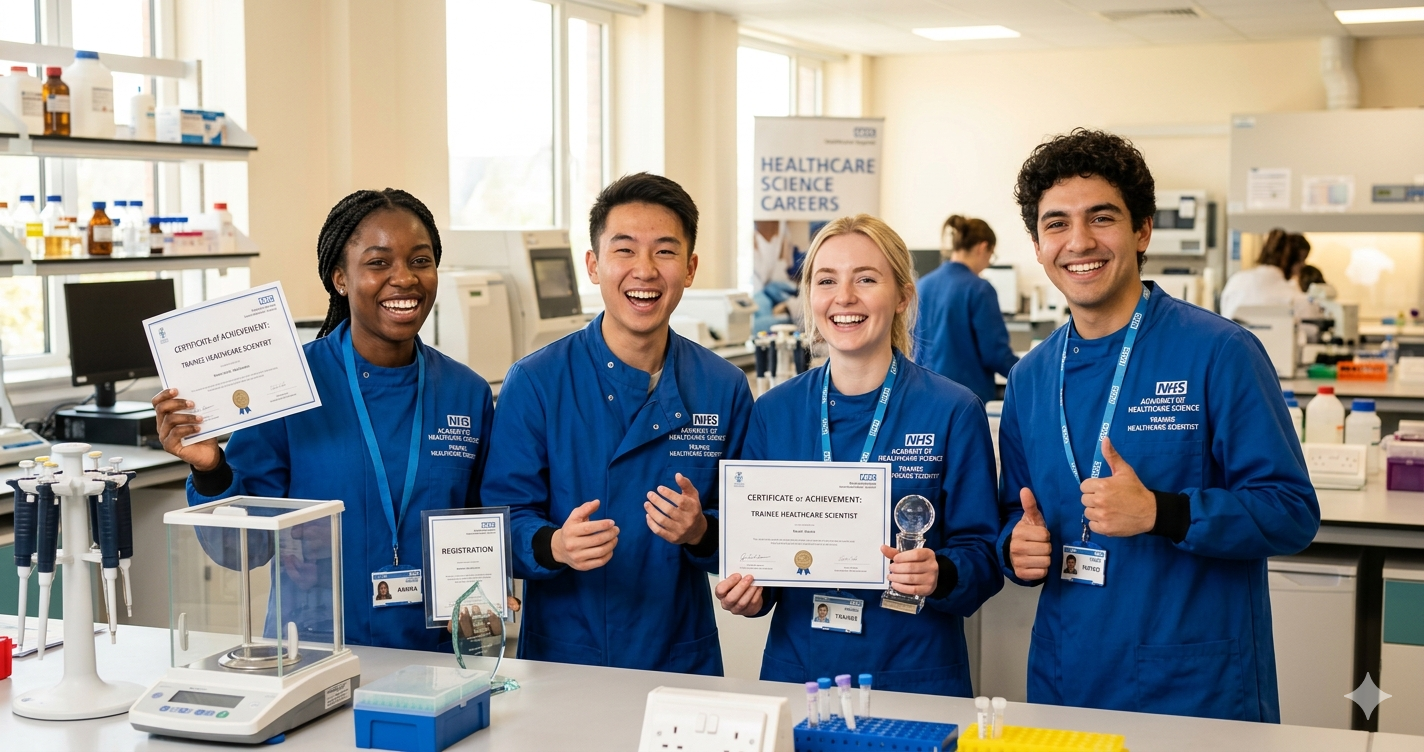
Securing a funded Master’s degree alongside a Band 6 salary is a rare pathway into the NHS, making this role a standout for science graduates. This position is designed for individuals who want to pivot their scientific background into a patient-facing clinical career without the burden of tuition fees. Based within the Gloucestershire Hospitals NHS Foundation Trust, you will be joining a department known for its commitment to professional development and high-quality diagnostic services.
What makes this opportunity particularly notable is the inclusion of visa sponsorship, opening doors for international talent to enter the UK healthcare system at a professional grade. You will not just be an employee; you will be a supernumerary trainee, meaning your primary purpose is to learn, observe, and grow. With a starting salary nearing £40,000 and a clear progression path to Band 7 upon qualification, this role offers both immediate financial stability and long-term career security.
Job Overview
| Job Title | Trainee Healthcare Scientist (Audiology) |
| Employer | Gloucestershire Hospitals NHS Foundation Trust |
| Location | Gloucestershire, UK |
| Salary | £39,959 – £48,117 per annum (Band 6) |
| Contract Type | Fixed term (3 years) |
| Hours | 37.5 hours per week |
| Visa Sponsorship Status | Visa Sponsorship Available |
| Closing Date | Not specified |
| Interview Date | Not specified |
What You’d Actually Be Doing
- Mastering diagnostic technology by learning to operate complex audiometric equipment to assess hearing and balance disorders. You will not just be pushing buttons; you will be interpreting the data to help form clinical diagnoses.
- Providing direct patient care through consultations with adults and children. This is a busy environment where you must balance technical precision with a gentle bedside manner, as many patients are distressed by their symptoms.
- Completing academic milestones as you work through a part-time MSc in Clinical Science. You will need to manage your time between the clinic and university blocks, often involving travel and independent research.
- Developing rehabilitation plans that include fitting hearing aids and providing counselling. You will see the immediate impact of your work as you help patients reconnect with the world through sound.
- Maintaining clinical standards by following strict NHS protocols and keeping accurate records. The role involves a lot of “behind-the-scenes” administration to ensure patient safety and departmental efficiency.
Who They’re Looking For
The trust requires a 2:1 or higher undergraduate degree in a relevant science subject such as biology, physics, engineering, or physiology. You must have a strong grasp of scientific principles and the ability to explain complex information to people who have no medical background. Excellent communication skills and a genuine desire to work in a public-facing healthcare setting are essential.
It is beneficial if you have previous experience in a customer service or healthcare environment, even if it was not in audiology. Familiarity with the NHS and a demonstrated interest in hearing science through volunteer work or specific modules in your degree will make your application stand out.
If you have a strong academic record and a heart for helping people, do not let a lack of specific audiology experience stop you from applying. This is a training role specifically designed to teach you the skills you lack.
What Most Applicants Get Wrong
- Failing to link their degree modules to audiology. Many applicants simply list their degree title without explaining how their knowledge of acoustics, human biology, or signal processing applies to hearing science.
- Ignoring the “Values-Based” nature of the NHS. Applicants often focus purely on their technical skills and forget to demonstrate how they meet the Trust’s core values, such as “caring” and “respect.”
- Underestimating the intensity of the Scientist Training Programme (STP). Candidates often fail to prove they have the time management skills to handle a full-time clinical job while simultaneously completing a Master’s degree.
How to Apply (and Actually Get Noticed)
- Review the person specification on the official NHS Jobs portal very carefully.
- Draft a personal statement that addresses every single “Essential” and “Desirable” criterion with a specific example from your life.
- Ensure your academic references are ready, as the trust will need to verify your degree class quickly for the university enrolment.
- Submit your application as early as possible. Many NHS trusts close vacancies early if they receive a high volume of high-quality applications.
- Check your email regularly for a link to any online aptitude or situational judgement tests that may be part of the first stage.
Visa and Eligibility
This role explicitly states that visa sponsorship is available, which is common for Band 6 healthcare scientist roles due to the shortage of qualified professionals in the UK. International candidates will need to meet the standard Skilled Worker visa requirements, including the English language proficiency test. You can find official guidance on the UK Government Health and Care Worker visa page.
Frequently Asked Questions
Here are answers to the most common questions people ask about this Trainee Healthcare Scientist role at Gloucestershire Hospitals NHS Foundation Trust, including eligibility, interview format, visa requirements and what to expect from the application process.
Is the MSc tuition fee covered by the NHS?
Yes, the NHS pays the full tuition fees for your Master’s degree as part of the Scientist Training Programme. You will receive your salary while also having your academic costs and some travel expenses to university fully funded.
Can international students apply for this audiology role?
International candidates are welcome to apply as this position offers visa sponsorship under the Health and Care Worker route. You must ensure your international degree is recognised as equivalent to a UK 2:1 honours degree.
What is the salary for a trainee healthcare scientist in audiology?
The starting salary for this role is £39,959 per annum, which corresponds to the start of NHS Band 6. This salary increases annually through the band increments and typically jumps to Band 7 once you are fully qualified.
Do I need a clinical background to apply for this post?
You do not need a prior clinical background, but you must have a relevant undergraduate degree in a science or engineering subject. The purpose of this three-year contract is to provide you with all the clinical training you need.
How many days a week will I spend at university?
You will typically follow a “block release” model, meaning you will work in the hospital for several weeks followed by a week or two of intensive study at a partner university. The exact split depends on the university’s academic calendar.
Will I have a guaranteed job after the three-year training?
While the training contract is for a fixed term of three years, successful completion of the MSc and clinical competencies usually makes you highly employable for permanent Band 7 roles within the same trust or elsewhere in the NHS.
What is the interview format for an NHS scientist role?
The interview usually involves a panel of senior scientists and managers who will ask a mix of technical scientific questions and values-based competency questions. You may also be asked to discuss a recent development in audiology research.
Where exactly in Gloucestershire is this job based?
The trust operates across multiple sites, primarily Gloucestershire Royal Hospital in Gloucester and Cheltenham General Hospital. You may be expected to rotate between these sites during your training.
Official Application Link
You can find the full job description and submit your formal application via the Trainee Healthcare Scientist (Audiology) at Gloucestershire Hospitals NHS Foundation Trust listing.