

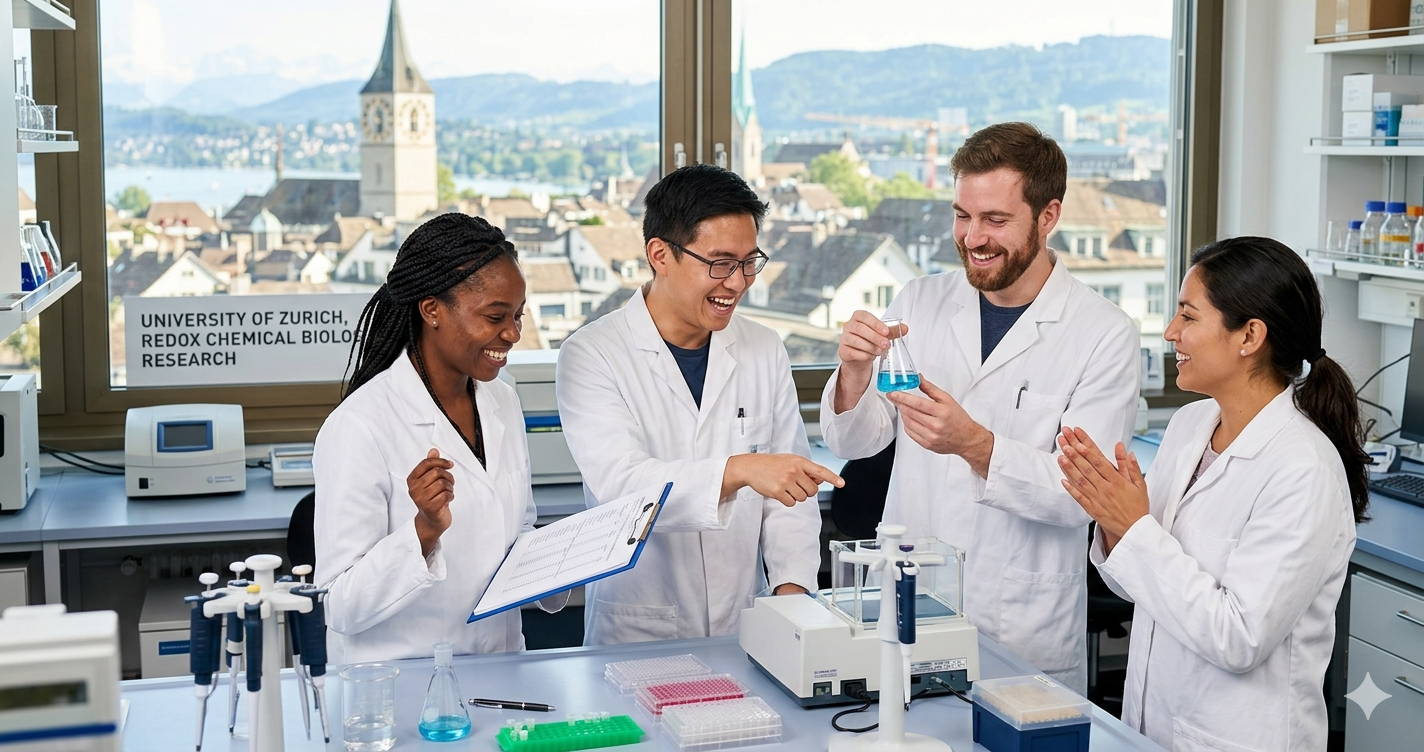
The University of Zurich (UZH) is offering an exciting PhD position in its Laboratory of Chemical and Biological Probes, under the supervision of Prof. Rivera Fuentes. This is a fully employed research role at one of Europe’s most prestigious and well-funded universities, located in Zurich, Switzerland. For aspiring researchers in biochemistry or molecular biology, this is a rare opportunity to work on groundbreaking science at the intersection of chemistry and living systems, using cutting-edge tools including artificial intelligence and genome editing.
This position is ideal for recent MSc graduates who have a strong foundation in molecular biology, biochemistry, or bioengineering and are passionate about developing new technologies to study biological processes. It is suited for candidates who are motivated, hands-on in the lab, and eager to contribute to research with real-world impact in redox biology and bioimaging.
This post covers everything you need to know about the position, including the responsibilities, eligibility requirements, application process, required documents, and tips to help you put together a strong application.
Scholarship Overview
| Field | Information |
| Host Country | Switzerland |
| Degree Level | PhD (Doctoral) |
| Funding Type | Employed Position (Salaried) |
| Deadline | May 31, 2026 |
| Who Can Apply | MSc holders in chemistry, biochemistry, molecular biology, or bioengineering |
| Benefits Summary | Competitive salary, flexible working, healthcare, subsidised food, language courses, and more |
Eligibility
To be considered for this PhD position, you must meet the following requirements:
- Citizenship: There is no stated restriction on nationality. Candidates from any country are encouraged to apply. UZH has an International Services department to support staff coming from outside Switzerland.
- Academic qualifications: You must hold an MSc degree in chemistry, biochemistry, molecular biology, or bioengineering. Candidates with only a background in synthetic organic, inorganic, or materials chemistry, with no experience in molecular biology, cell biology, or biochemistry are explicitly not suitable for this role.
- Work experience (if applicable): Prior research experience is not mandatory, but previous exposure to de novo protein design, directed evolution, redox biology, bioinformatics, or machine learning is considered a strong advantage.
- Language requirements: Proficiency in oral and written English is a formal requirement of the position.
- Other requirements: You must be highly motivated and genuinely interested in developing technologies to visualize proteins in complex biological samples. The role involves little to no synthetic organic chemistry, so your interest and experience must align with the molecular biology and biochemistry aspects of the work.
Eligible Countries
This position does not specify any country restrictions. As UZH actively recruits internationally and provides support services for international staff, applicants from all countries are welcome to apply.
- Africa: All countries
- Asia: All countries
- Americas: All countries
- Europe: All countries
- Middle East: All countries
- Other: All countries and territories
Eligible Fields of Study
This position is specifically targeted at candidates from the following fields:
- Molecular Biology
- Biochemistry
- Bioengineering
- Chemistry (with relevant biological/biochemical experience)
Note: Applicants whose background is purely in synthetic organic chemistry, inorganic chemistry, materials chemistry, engineering, or theoretical chemistry, with no exposure to molecular biology or cell biology, are explicitly not suitable for this role. Your academic background must include hands-on experience with biological systems.
Benefits
As a PhD student employed at the University of Zurich, you receive a comprehensive package of benefits:
- Salary/Stipend: You are employed under Swiss public law, which means you receive a competitive salary for a PhD-level position.
- Living support: Access to subsidised food and drinks at UZH cafeterias, plus a Lunch-Check card with a UZH contribution.
- Healthcare: Free seasonal flu vaccinations, access to special rates at the Academic Sports Association (ASVZ), and a quiet rest room for wellbeing.
- Flexible working: Flexible working models are available, including part-time options, mobile working, and job-sharing arrangements.
- Childcare: Access to the kihz foundation childcare facility, run jointly by UZH and ETH Zurich.
- Learning and development: A wide range of continuing education courses at UZH and the Canton of Zurich, plus access to a Language Center run jointly with ETH Zurich.
- Discounts: Special rates on carsharing, vehicle rental, parking, hardware, software, mobile subscriptions, and hotel reservations.
- International support: Dedicated International Services support for staff arriving from outside Switzerland, covering immigration, relocation, and settlement.
Required Documents
Submit your application as a single PDF file that includes all of the following:
- Motivation letter: A concise letter that includes a clear summary of your research experience, your interest in the lab’s work, and why you are a good fit for this specific position.
- Curriculum Vitae (CV): A full academic and professional CV, highlighting your laboratory skills, research experience, publications (if any), and relevant coursework.
- Academic transcripts: Copies of your official university transcripts, covering your undergraduate and MSc studies.
- Letters of recommendation: These are only required if you are shortlisted. Do not include them in your initial application.
Note: Incomplete applications will not be considered. All documents must be combined into a single PDF before submission.
How to Apply
Follow these steps carefully to submit a complete and competitive application:
Step 1: Read the full job posting on the UZH careers page to confirm you meet all eligibility requirements before investing time in your application.
Step 2: Research the Laboratory of Chemical and Biological Probes and Prof. Rivera Fuentes. Visit the group’s website and read the two key publications mentioned: Nat. Chem. 2023, 15, 1415 and Redox Biol. 2025, 81, 103560. Understanding the lab’s ongoing work will help you write a targeted motivation letter.
Step 3: Write your motivation letter. It must include a concise summary of your research experience. Tailor it specifically to the lab’s focus on redox biology, fluorescent probes, and chemical biology tools.
Step 4: Update and format your CV to highlight the most relevant skills such as protein work, cell biology techniques, bioinformatics, or any machine learning experience.
Step 5: Gather your academic transcripts from all universities attended. Make sure they are legible and clearly show the degree awarded and grades obtained.
Step 6: Combine your motivation letter, CV, and transcripts into a single PDF file. Ensure the file is well-organised and easy to read. Label it clearly with your name.
Step 7: Submit your application through the official UZH application portal (see the Official Link section below). Do not send applications by email unless instructed otherwise.
Step 8: Confirm receipt of your application. If the portal provides a confirmation email, save it as proof of submission.
Step 9: If you are shortlisted, you will be contacted and asked to provide letters of recommendation at that stage. Prepare two or three academic referees in advance so you are ready to respond quickly.
Step 10: Prepare for a potential interview. Be ready to discuss your research experience, your interest in redox biology, and your ability to work in an interdisciplinary setting.
Key Dates and Timeline
| Milestone | Date |
| Application Opens | To be Determined |
| Application Deadline | May 31, 2026 |
| Shortlisting | To be Determined |
| Interviews | To be Determined |
| Final Results | To be Determined |
| Programme Begins | To be mutually agreed |
Application Deadline
The application deadline is May 31, 2026.
Applications submitted after this date will NOT be accepted. Incomplete applications will also be disqualified, so please ensure your single PDF file is complete before submitting.
Selection Criteria
The selection panel will evaluate candidates beyond basic eligibility. Here is what they are looking for:
- Academic excellence: A strong MSc record in a relevant field. Your transcripts should demonstrate a solid foundation in molecular biology or biochemistry.
- Research experience: Evidence that you have actually worked in a lab setting, handled biological systems, and can contribute meaningfully from day one.
- Alignment with the lab’s focus: The strongest candidates will demonstrate genuine interest in redox biology and chemical probes, ideally shown through prior coursework, thesis projects, or publications.
- Technical skills: Familiarity with techniques such as protein expression and purification, cell imaging, genome editing, or bioinformatics will set you apart. Experience with machine learning or AI tools used in biological research is a notable advantage.
- Communication ability: Since the role requires writing reports and papers, as well as presenting at national and international conferences, the committee will look for candidates who can communicate complex ideas clearly in English.
- Motivation and fit: The motivation letter is your chance to show the panel why this specific lab and project excites you. Generic letters will not stand out.
Important Tips
- Tailor your motivation letter specifically to this lab. Reference the published papers by the group and explain what excites you about the direction of their research. A generic letter will not get you far.
- Be honest about your background. The posting explicitly rules out candidates with only synthetic or inorganic chemistry experience. Do not apply if your background does not include meaningful molecular biology or biochemistry work.
- Combine all documents into a single PDF before submitting. The posting is very clear about this requirement. Submitting multiple files or missing documents will disqualify your application.
- Do not include recommendation letters in your initial application. They are only required at the shortlisting stage. Including them prematurely adds unnecessary bulk to your PDF.
- Apply well before the May 31 deadline. Do not wait until the last day. Technical issues or poor internet connections can cause delays that cost you the opportunity.
- Brush up on recent developments in redox biology, fluorescent probe technology, and AI-assisted protein modeling before any interview. These are core themes of the lab’s work.
- Prepare your referees in advance. Even though letters of recommendation are only requested after shortlisting, inform your referees early so they are ready to write quickly when needed.
- Visit the group website and study the ongoing projects. Showing in your letter that you understand not just what the lab has published, but where it is headed, will make you a much more compelling candidate.
- If you have questions about the role, use the official contact form to reach Prof. Rivera Fuentes. Keep your message brief, professional, and specific. Do not ask questions already answered in the job posting.
Frequently Asked Questions
Is this position open to international applicants from outside Switzerland or Europe?
Yes. The University of Zurich recruits internationally and has a dedicated International Services department to support staff relocating from outside Switzerland. There is no stated nationality restriction for this position.
Do I need to speak German to apply or work at UZH?
Proficiency in English (oral and written) is listed as a formal requirement. German is not mentioned as a requirement. However, living in Zurich will be easier with some German, and UZH offers language courses through its Language Center if you want to develop those skills after joining.
I have a background in organic chemistry but no experience in molecular biology. Can I apply?
No. The job posting clearly states that applicants with only a background in synthetic organic, inorganic, or materials chemistry and no experience in molecular biology, cell biology, or biochemistry are not suitable for this position.
What salary can I expect as a PhD student at UZH?
Swiss PhD salaries are among the most competitive in the world.You are encouraged to check the UZH website or contact the department for specifics.
Should I include letters of recommendation with my initial application?
No. The posting specifically states that letters of recommendation will only be required for shortlisted candidates. Do not include them in your initial single PDF application.
When does the PhD position start?
The start date is to be mutually agreed between the successful candidate and the laboratory. If you have constraints, you can discuss this during the interview or offer stage.
What does 80% employment mean in the context of this position?
In Switzerland, employment contracts often specify the percentage of full-time work. An 80% position means you are employed at four-fifths of a full working week. This is fairly standard for PhD positions in Switzerland and still includes access to all UZH employee benefits.
Is there a possibility of extending the PhD or transitioning to a postdoc after completion?
It is a good question to raise directly with Prof. Rivera Fuentes during the application or interview process.
Official Link
To apply and for full details, visit the official UZH job posting page: